The problem
Organisations spend significant budget on employee wellbeing programmes without clear evidence of where the real risks lie, which demographic groups are most affected, or whether interventions are working. Survey data sits in spreadsheets, leadership gets anecdotal reports, and decisions are made on gut feel rather than evidence.
Robertson Cooper needed an analytical system that could turn large-scale survey data into defensible, actionable insight, something a leadership team could present to a board and a people team could use week to week.
What I did
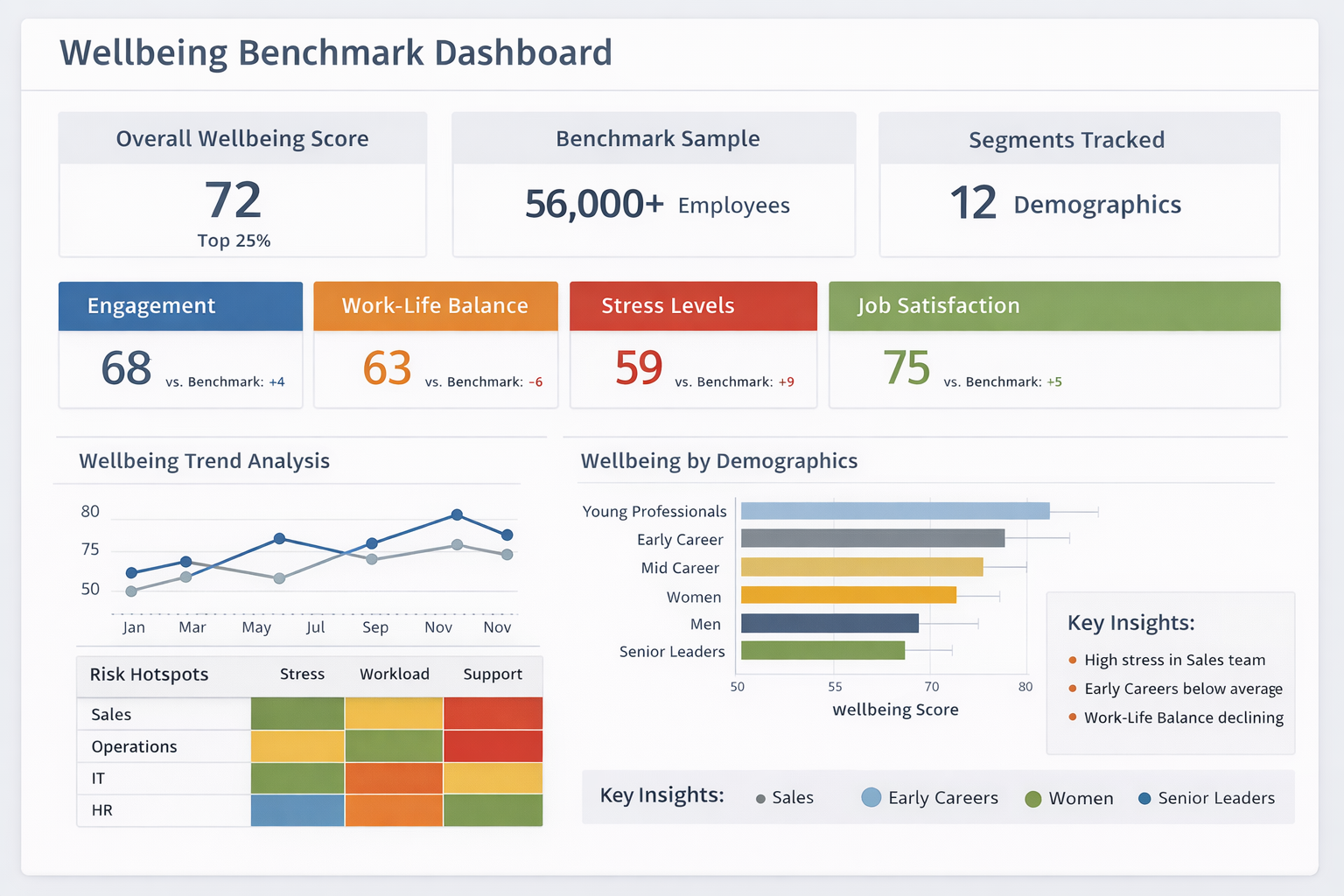
I built an end-to-end benchmarking and predictive analytics pipeline that integrated 12 validated wellbeing, engagement, and performance metrics. The framework enabled comparison of any client organisation against a General Working Population benchmark drawn from 56,000+ survey responses.
The predictive driver models identified which specific wellbeing factors — stress, autonomy, line manager quality, workload — were most strongly linked to productivity loss, presenteeism, and attrition risk in each organisation. Leadership could finally see not just that wellbeing scores were low, but why, and where to act first.
The pipeline was built with Git-versioned CI workflows, making results reproducible and auditable — important when clients need to track change over time or present findings to regulators and investors.
Technical approach
- Multi-metric integration across 12 validated survey instruments
- Demographic stratification across 12 population segments
- Driver modelling using regression & feature importance analysis
- Git CI/CD pipeline for reproducible, versioned reporting
- Risk hotspot identification at team and department level
Business outcomes
- Enabled benchmark comparison vs 56,000+ employee General Working Population
- Predictive models explained ~75% of variance in productivity & attrition
- Leadership teams received board-ready dashboards with clear risk priorities
- Reproducible pipeline reduced reporting time on repeat engagements
- Identified demographic groups most at risk before symptoms escalated
Why this matters for your organisation
If you run employee surveys and struggle to translate them into decisions, this is exactly the kind of work I do. Whether you need a one-off benchmarking report or an ongoing analytical layer on top of your existing data, the methodology is the same: clean data, validated metrics, models that explain rather than just describe.
This type of analysis is particularly valuable for HR teams preparing for board reviews, organisations going through significant change, and people analytics functions that need to move beyond headcount and eNPS scores.